

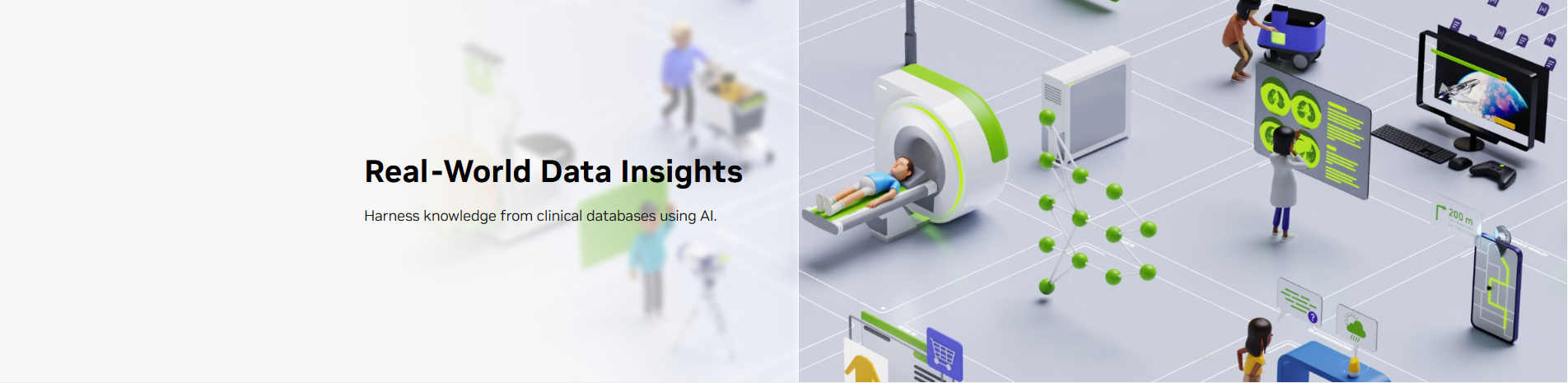
In the healthcare industry, gathering insights from real-world data is becoming essential for improving clinical trial processes and overall system efficiency. AI tools can enhance this by evaluating large volumes of available data on clinical trials. Examples of applications include screening of clinical trial participants and identifying eligible individuals faster. It can also integrate diverse data types for comprehensive analysis, enabling patient-trial matching.
AI-driven cohort audit analysis helps ensure the integrity of study group compositions, while generative AI can support second opinions by providing expert-level evaluations based on vast medical knowledge. Additionally, AI enhances disease and symptom search functionalities, supported pandemic response efforts, and helps maintain financial integrity by optimizing revenue cycle management.
In the era of precision medicine, real-world clinical data (RWCD)—encompassing electronic health records (EHRs), medical imaging, genomic sequences, laboratory tests, and wearable device data—has emerged as a treasure trove of insights that can transform healthcare delivery, drug development, and public health decision-making.
However, the sheer volume, heterogeneity, and complexity of these data pose insurmountable challenges for traditional analytical methods. Artificial intelligence (AI) tools, with their unparalleled ability to process and analyze large-scale unstructured and structured data, have become indispensable engines for mining real-world clinical data, turning raw information into actionable intelligence that drives innovation in healthcare.
Real-world clinical data is characterized by its diversity, dynamism, and proximity to actual clinical practice, making it far more reflective of real healthcare scenarios than controlled clinical trial data. Yet, extracting meaningful patterns from this data ocean was once a time-consuming and error-prone task.
AI tools have revolutionized this process by breaking through three key bottlenecks:
First, they enhance the efficiency of data processing. Traditional manual sorting and analysis of EHRs, which can be tens of gigabytes per patient, often take days or even weeks. In contrast, AI-powered natural language processing (NLP) engines can process millions of medical records in seconds, automatically extracting key information such as diagnostic conclusions, medication histories, and surgical procedures with an accuracy rate of over 92% <superscript>1. Second, they improve the depth of data utilization.
AI tools can integrate multi-modal data—including medical images, genomic data, and real-time vital signs—to uncover hidden correlations that single-modal analysis cannot detect.
For example, Stanford University’s CheXpert system, which combines chest X-ray images with patient medical histories, achieves a pneumonia detection accuracy of 94.7%, 8 percentage points higher than single-modal analysis<superscript>1. Third, they enable proactive healthcare management. By mining longitudinal real-world data, AI models can predict disease risks, such as the onset of diabetes or hypertension, and provide personalized preventive suggestions, shifting healthcare from a reactive to a proactive model.automatically extracting key information such as diagnostic conclusions, medication histories, and surgical procedures with an accuracy rate of over 92% <superscript>1. Second, they improve the depth of data utilization.