

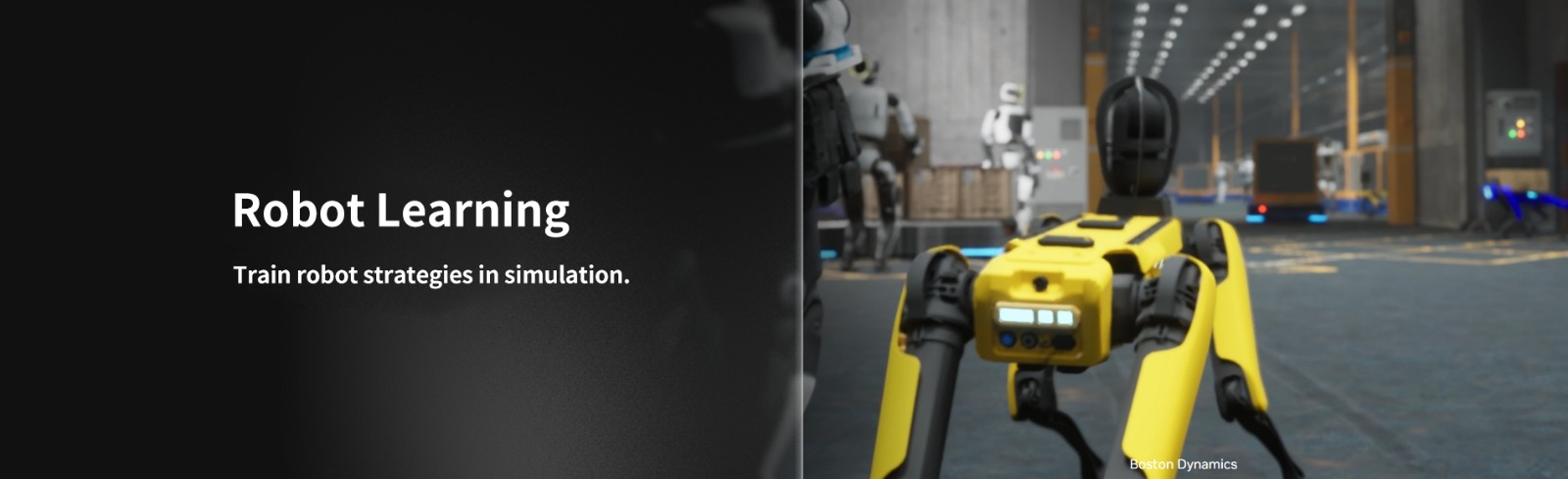
AI robots address these limitations through simulation-based learning, enabling them to autonomously perceive, plan, and act under dynamic conditions. Through robot learning, they can leverage learned strategies (e.g., navigation and operational behavior sets) to acquire and refine new skills, enhancing their decision-making capabilities across various scenarios.
The "sim-first" approach also allows you to quickly train hundreds or thousands of robot instances. By leveraging diverse data sources—including real data captured by robots and synthetic data from simulations—you can iterate, optimize, and deploy robot strategies for real-world scenarios. This applies to any robot form factor, such as Autonomous Mobile Robots (AMRs), robotic arms, and humanoid robots.
One core advantage of simulation-based robot learning is accelerated skill development: robots can quickly adapt to new task variations in virtual environments without reprogramming physical hardware, greatly shortening the skill iteration cycle.
The physically accurate simulation environment precisely replicates physical factors like object interactions (rigid or deformable) and friction, effectively bridging the simulation-to-reality gap and making virtually trained strategies more applicable to real-world scenarios. Meanwhile, simulation provides a safe validation space where high-risk scenarios can be fully tested without endangering personnel or damaging equipment.
In terms of cost, generating massive synthetic data, validating robot strategies in simulation and then deploying them eliminates the heavy burden of real-world data collection and labeling costs, thus comprehensively supporting robot skill development across four dimensions: efficiency, precision, safety and cost.
Robot learning algorithms (such as imitation learning or reinforcement learning) can help robots learn skills in a generalized way and improve performance in changing or novel environments.