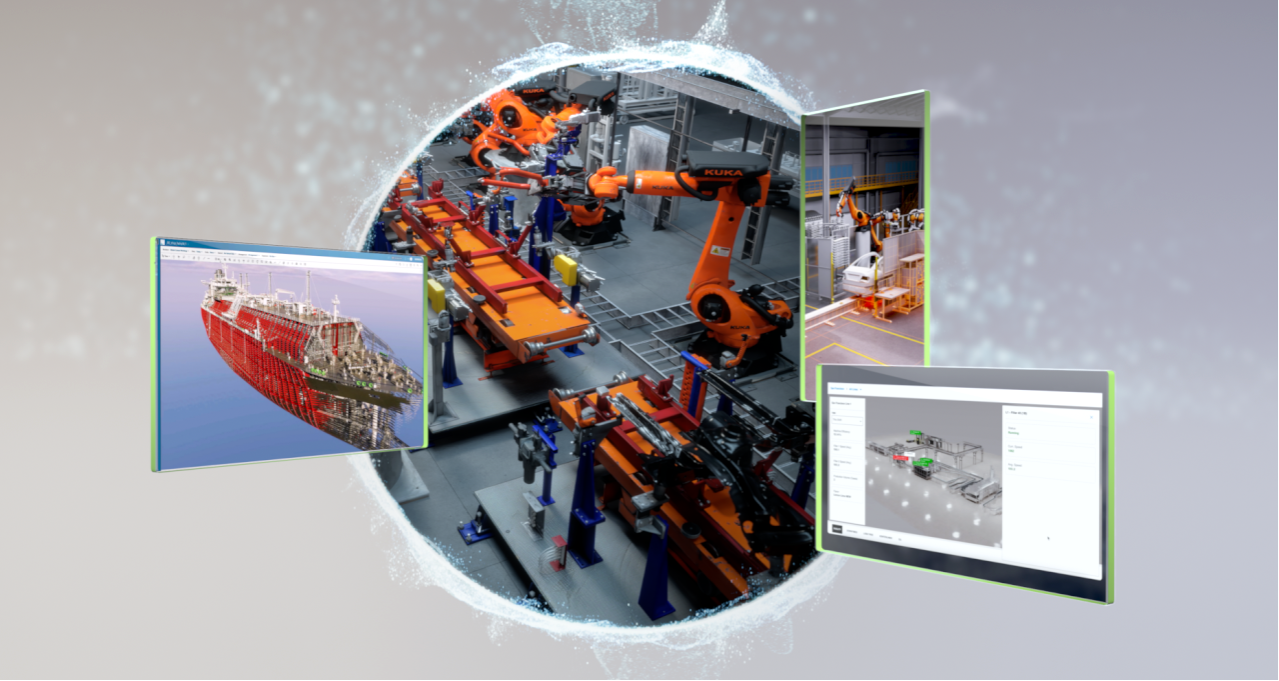
Investments in Industrial AI and Physical AI are driving growing demand for digital twins across industries.
These virtual replicas of real-world environments, facilities, and processes achieve physics-level accuracy, and they not only help manufacturers optimize planning and operations but also serve as safe, efficient, and reliable training grounds for visual AI agents, intelligent vehicles, and robots.
Building such physically accurate simulation environments can facilitate the seamless transition of Physical AI into the real world, yet creating them typically requires substantial human effort. However, leveraging the latest advancements in OpenUSD—a powerful open standard for describing and connecting complex 3D worlds—along with optimized rendering, neural reconstruction, and World Foundation Models (WFM), developers can accelerate the construction of large-scale digital twins.
To accelerate the development of digital twins and Physical AI, NVIDIA unveiled new research findings, the NVIDIA Omniverse library, the NVIDIA Cosmos World Foundation Models, and advanced AI infrastructure such as NVIDIA RTX PRO Servers and NVIDIA DGX Cloud at this year’s SIGGRAPH.
The latest Omniverse Software Development Kit (SDK) integrates MuJoCo with Universal Scene Description (OpenUSD), enabling over 250,000 MJCF robotics learning developers to conduct robot simulations across various platforms.
The Omniverse NuRec library and AI models support Omniverse RTX ray-traced 3D Gaussian splatting, allowing developers to capture, reconstruct, and simulate the real world in 3D using sensor data.
NVIDIA Isaac Sim 5.0 and Isaac Lab 2.2—open-source robotics simulation and learning frameworks—are now available on GitHub. Isaac Sim adopts NuRec neural rendering and the new OpenUSD Robotics and Sensor Schema, further bridging the gap between simulation and reality.
Cosmos World Foundation Models such as Cosmos Transfer-2 and NVIDIA Cosmos Reason significantly enhance synthetic data generation and reasoning capabilities for Physical AI development. Advances by NVIDIA Research in rendering and AI-aided material generation help developers scale up digital twin development.