

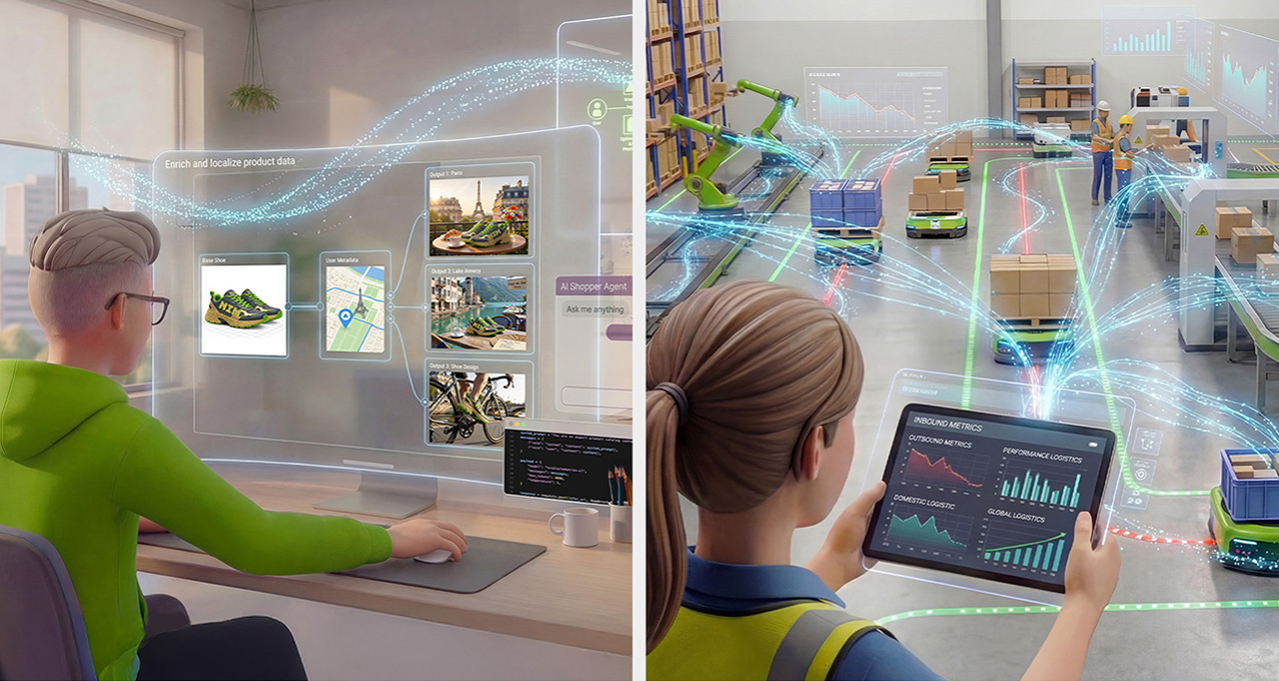
The warehouse is a dynamic space teeming with constant movement—from cartons stocked with a diverse range of retail goods, to the extensive machinery and workers fulfilling thousands of orders each day. Issues can arise in an instant: from out-of-stock items to the need for debris clearance in aisle four.
A persistent challenge in this work environment is the disconnect between the information technology (IT) layer and operational technology (OT) layer. This rift hinders managers from responding promptly to critical tasks, such as accurately measuring product inventory, pinpointing technical malfunctions efficiently and precisely, and deploying sufficient manpower to areas in need of support.
Hammadou stated: "Deploying agent-based AI on either the IT or OT layer alone is inefficient; true value is unlocked when AI agents are positioned between IT and OT to act as coordinators."
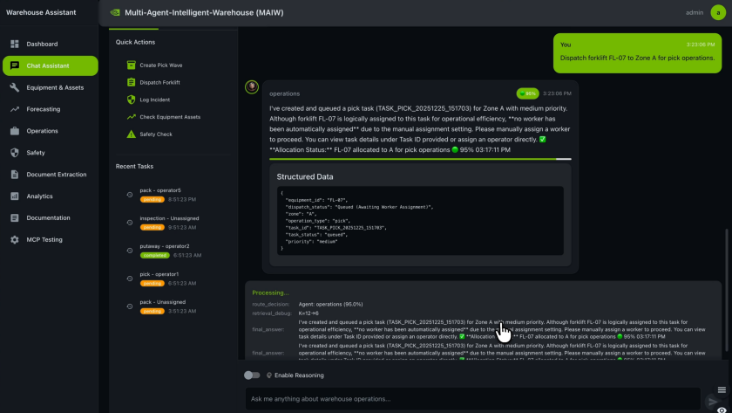
NVIDIA’s MAIW Blueprint builds a synchronized AI system that integrates existing warehouse management systems, enterprise resource planning (ERP) platforms, robotics, and IoT data, empowering teams with real-time, explainable operational intelligence.
The blueprint comprises a suite of specialized AI agents—each tasked with equipment asset management, collaborative operations, safety and compliance, predictive analytics, and document processing—all orchestrated by a central Warehouse Operations Assistant. This assistant mimics the actual operational patterns of the warehouse and transforms fragmented data into proactive decision-making capabilities.
For example, a supervisor can pose a natural language query such as: “Why is packaging speed slow?” The AI assistant will then analyze equipment status, task queues, and staffing data to identify bottlenecks, present supporting evidence, and recommend optimizations like workload reallocation or task priority adjustment.
The blueprint also delivers production-grade capabilities—including role-based access control and guardrails to ensure policy alignment of recommendations—enabling operations teams to trust AI to play a role in real-world equipment collaboration and safety-critical decision-making.
By setting targeted metrics to detect and resolve issues and safety incidents, while ensuring on-time order fulfillment and service level agreement (SLA) compliance, MAIW helps warehouses shift from constant reactive firefighting to a more predictable, data-driven operational model.
Partners such as product and technology development firm Kinetic Vision can leverage the MAIW Blueprint to innovate and solve longstanding retail supply chain challenges that have persisted for decades.
“Charts and graphs are outdated—what we need are predictions and actionable action plans,” said Jeremy Jarrett, CEO of Kinetic Vision. “NVIDIA’s MAIW Blueprint will provide a more centralized way to answer questions and drive decision-making.”