

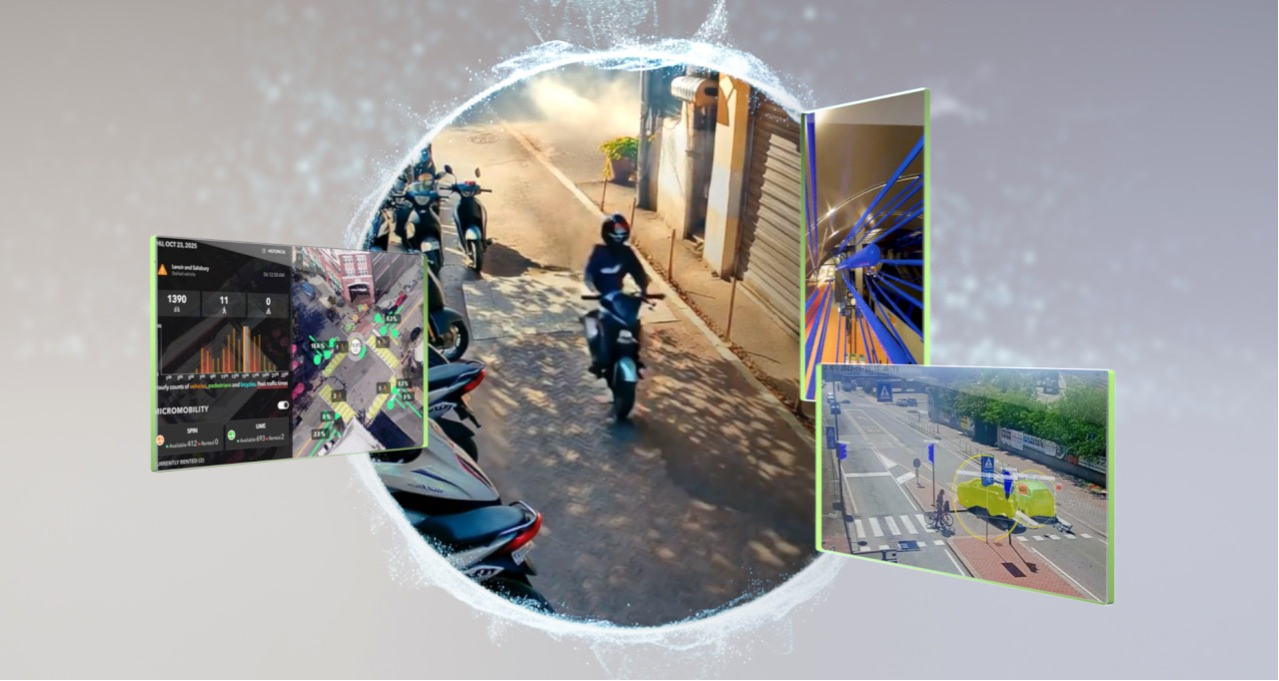
This article is part of the Insights into Omniverse series. “Insights into Omniverse” highlights how developers, 3D practitioners, and enterprises are transforming their workflows with the latest advancements in OpenUSD and NVIDIA Omniverse.
Cities around the world face unprecedented challenges: rapid urban population growth, while infrastructure struggles to keep pace.
Operational challenges such as traffic congestion and coordinated emergency services are further complicated by fragmented data workflows, siloed local processes, and inconsistent systems. Technical barriers prevent cities from accessing the comprehensive, real-time insights required for effective decision-making and urban management.
Leading cities and technology partners are deploying the NVIDIA Blueprint for Smart City AI, a reference application that provides a complete software stack for building, testing, and operating AI agents for SimReady digital twins.
OpenUSD is an open and extensible framework that connects every stage of this physical AI workflow. OpenUSD-enabled digital twins serve as SimReady environments, where cities can simulate “what-if” scenarios and generate physically accurate sensor data.
The blueprint enables a three-stage workflow:
1、Simulation using the NVIDIA Cosmos platform and NVIDIA Omniverse libraries to generate synthetic data;
2、Training and fine-tuning vision AI models;
3、Deploying real-time video analytics AI agents using the NVIDIA Metropolis platform and the NVIDIA Blueprint for Video Search & Summarization (VSS).
These capabilities enable cities to shift from reactive to proactive operations.
Based on these simulations, cities can deploy unified operations platforms that integrate weather data, traffic sensors, and emergency response systems, supporting rapid testing of rare scenarios, real-time monitoring, urban infrastructure planning, and optimization of city systems.
From Kaohsiung City reducing incident response time by 80% with street-level AI, to Raleigh, North Carolina achieving 95% vehicle detection accuracy, and France’s railway network optimizing energy consumption by 20%, cities worldwide are transforming urban operations at scale with digital twins and AI agents.
Smart Cities in Action
Akila and SNCF Gares & Connexions Improve Rail Operations with Digital Twins
Akila’s digital twin application helps French railway operator SNCF Gares & Connexions optimize its network of nearly 14,000 daily trains, enabling solar heating, airflow management, and crowd flow control through real-time scenario planning. The OpenUSD-based digital twin has helped reduce energy consumption by 20%, achieve 100% on-time preventive maintenance, and cut downtime and response time by 50%.
Linker Vision Delivers Street-Level Intelligence with Physics AI
Linker Vision’s physics AI system identifies infrastructure incidents in Kaohsiung, including damaged streetlights and fallen trees, reducing the need for manual urban inspections and accelerating emergency response. To scale its street-level intelligence to more cities, Linker Vision uses Omniverse libraries for simulation, Cosmos Reason for world understanding, and deploys via the OpenUSD-powered VSS Blueprint.
Esri and Microsoft Enable Full Urban Intelligence in Raleigh
The City of Raleigh uses the NVIDIA DeepStream SDK to achieve 95% vehicle detection accuracy, boosting engineer efficiency for traffic analysis. This data strengthens Raleigh’s digital twin built on Esri’s ArcGIS geospatial platform, providing visual analytics for critical infrastructure planning and management. By integrating computer vision pipelines with visual AI agents based on the NVIDIA VSS Blueprint, the system delivers comprehensive real-time visualization and deep insights on the ArcGIS platform hosted in the Azure cloud.
Milestone Systems’ VLM Automates Video Review
Milestone Systems is launching Hafnia VLM, which will include a VLM plugin for its XProtect video management software and VLM as a service. Fine-tuned on over 75,000 hours of video data, Hafnia VLM reduces operator alert fatigue by up to 30% by automating video review and filtering false alerts. It is developed with NVIDIA Cosmos Reason VLM and Metropolis. The Hafnia VLM plugin for XProtect will make generative AI more accessible to XProtect operators and users.
K2K Analyzes Video Streams in Italy
K2K’s platform analyzes more than 1,000 video streams across Palermo, Italy, using NVIDIA Cosmos Reason and the VSS Blueprint, processing 7 billion events annually. When critical conditions are detected and analyzed, the system automatically notifies municipal officials via natural language queries and video event alerts.
Watch the NVIDIA GTC on-demand session “Leadership Strategies to Transform Public Services” to learn how cities are transforming through simulation, visual AI, and digital twins.