

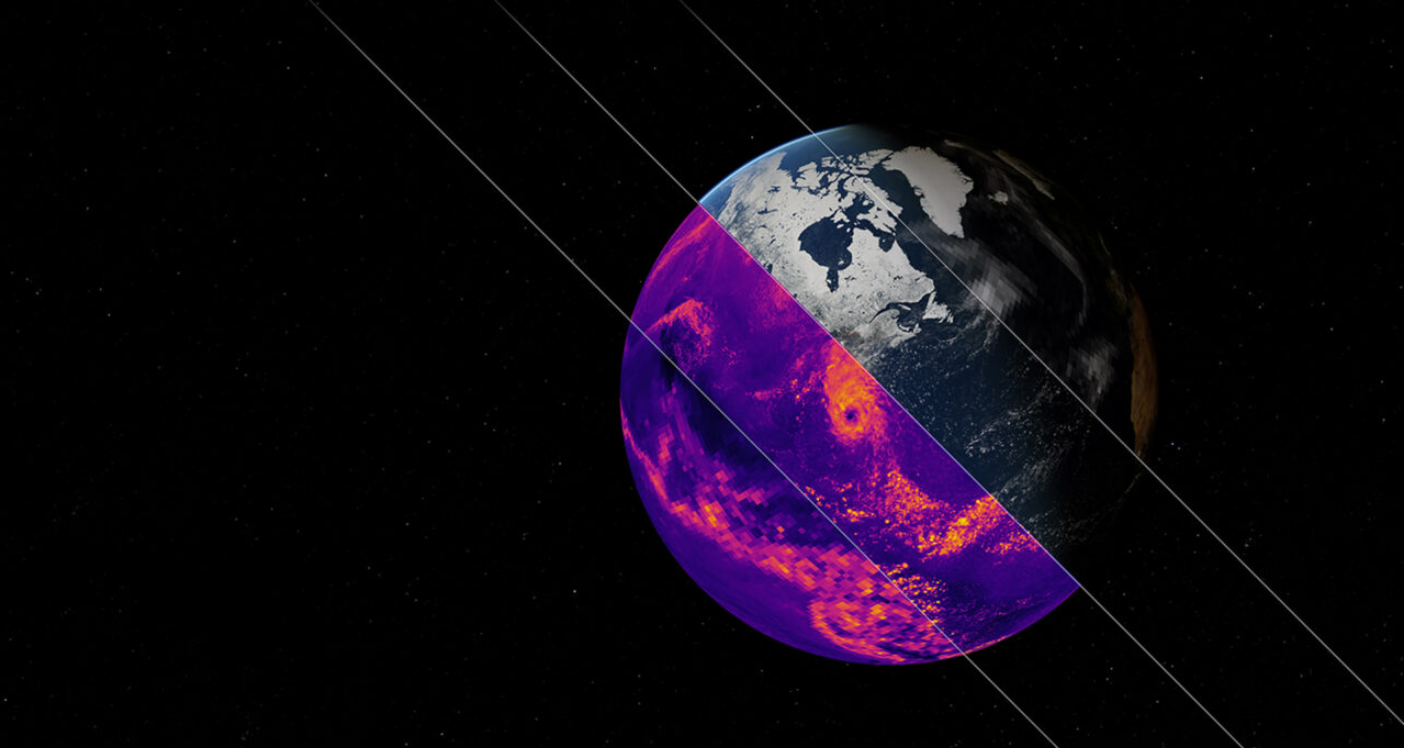
By simulating Earth’s climate in greater detail, scientists and researchers can better predict and mitigate the impacts of climate change.
NVIDIA is delivering new breakthroughs for this effort with cBottle (short for Climate in a Bottle), the world’s first generative AI foundation model designed specifically for simulating global climate at kilometer-scale resolution.
As part of the NVIDIA Earth‑2 platform, the model can generate realistic atmospheric states and be conditioned on inputs such as time, date, and sea surface temperature, opening new avenues to understand and predict Earth’s most complex natural systems.
The Earth‑2 platform comprises a software stack and tools that integrate the power of AI, GPU acceleration, physical simulation, and computer graphics. This enables the creation of interactive digital twins for simulating and visualizing weather conditions, as well as planetary-scale global climate forecasting. With cBottle, these forecasts can be delivered thousands of times faster and more efficiently than traditional numerical models, without compromising accuracy.
Leading scientific research institutions, including the Max Planck Institute for Meteorology (MPI‑M) and the Allen Institute for AI (Ai2), are exploring the use of cBottle to compress and distill Earth observation data and ultra-high-resolution climate simulations into queryable, interactive generative AI systems.
cBottle was field-tested at the World Climate Research Programme (WCRP) Global Kilometric Hackathon, organized by eight countries and ten climate modeling centers to advance the analysis and development of high-resolution Earth system models and broaden access to high-resolution, high-fidelity climate data.
Revolutionizing Climate Modeling with AI
Traditional climate informatics requires complex analysis of tens of petabytes of data storage, demanding massive investments of time, human effort, and computing resources.
Combining NVIDIA GPU acceleration and the highly optimized NVIDIA Earth‑2 stack, cBottle uses advanced AI techniques to compress massive climate simulation datasets. It can compress petabyte-scale volumes by up to 3,000 times for a single weather sample — equivalent to reducing a 1,000-sample ensemble to one three‑millionth of its original size.
cBottle is trained on high-resolution physical climate simulations and atmospheric state estimates constrained by 50 years of observational data.
The model can fill in missing or corrupted climate data, correct biased climate models, super-resolve low-resolution climate data, and synthesize information based on patterns and prior observations. cBottle’s extreme data efficiency allows it to be trained on just four weeks of kilometer-scale climate simulation data.
Global Collaboration for Planetary‑Scale Impact
Leading climate institutions are using NVIDIA Earth‑2 to advance climate simulation.
The Max Planck Institute for Meteorology has pioneered kilometer-scale climate modeling using Earth‑2 and its ICON Earth system model. With NVIDIA GPU acceleration and performance optimizations, the institute’s team led the first kilometer-scale simulation of the entire Earth system, enabling climate modeling and visualization at unprecedented detail.
“Amid a rapidly changing climate, the latest advances in Earth‑2 represent a revolutionary leap forward in our ability to understand, predict, and adapt to the world around us,” said Bjorn Stevens, Director of the Max Planck Institute for Meteorology. “By harnessing NVIDIA’s advanced AI and accelerated computing, we are building a digital twin of Earth. This marks a new era where climate science becomes accessible and actionable for all, empowering people to make informed decisions to protect our collective future.”
The Allen Institute for AI and NVIDIA are collaborating to accelerate and enhance climate modeling using the Earth‑2 AI stack and GPUs, with the goal of making high-resolution climate simulations faster, more energy-efficient, and easier to use. This is critical for research and real‑world applications in weather prediction and climate resilience.
“Planning for climate change is one of the great challenges facing nations worldwide,” said Christopher Bretherton, Senior Director of Climate Modeling at the Allen Institute for AI. “cBottle’s elegant use of generative AI makes it an exciting new resource for efficiently simulating local extreme weather events such as heavy rain or dry, windy conditions that fuel wildfires.”
Using cBottle within NVIDIA Earth‑2, developers can build climate digital twins that enable interactive exploration and visualization of kilometer-scale climate data, as well as prediction of likely scenarios with low latency and high throughput.
Early access to the cBottle foundation model is now available. Climate AI researchers interested in retraining the model can access the cBottle code repository on GitHub and review the preprint on arXiv.