

This year’s ROSCon was held in Singapore, drawing global attention from developers in the Robot Operating System (ROS) community. ROS is currently the most widely used open-source framework for robotics development worldwide.
The conference runs through Wednesday, October 29. At the event, NVIDIA announced collaborations with partners and the Open Source Robotics Alliance (OSRA), while launching new robotics software to advance open standards and accelerate robotics development.
NVIDIA is supporting the newly formed Physical AI Special Interest Group under OSRA, which focuses on three key areas: real-time robot control, accelerated AI processing efficiency, and the development of tools for more adaptive autonomous robot behavior.
The core goal of these initiatives is to make ROS 2 the preferred framework for real-world robotics applications, combining open-source flexibility with high performance.
NVIDIA is directly injecting GPU-aware abstraction layers into ROS 2, enabling it to recognize and efficiently manage a wide range of processors, including CPUs, integrated GPUs, and discrete GPUs. This technology not only ensures sustained high-performance computing but also equips the entire ROS ecosystem with future-proof evolutionary capabilities, keeping ROS aligned with the rapid pace of hardware innovation.
To help developers improve robot performance and reliability, NVIDIA has also open-sourced the Greenwave Monitor tool. With this tool, developers can quickly identify performance bottlenecks, shortening the robotics development cycle.
In addition, NVIDIA announced that NVIDIA Isaac ROS 4.0—a new suite of ROS-compatible, GPU-accelerated libraries and AI models—is now available on the NVIDIA Jetson Thor platform for deploying physical AI and robotics applications. Developers can access and run Isaac’s CUDA-accelerated libraries, AI models, and workflows tailored for robot manipulation and mobility.
Industry Leaders Adopt NVIDIA AI, Accelerated Computing, and Open-Source Technologies
NVIDIA’s open-source technologies have empowered global developers and partners to advance the training, simulation, and deployment of next-generation robots.
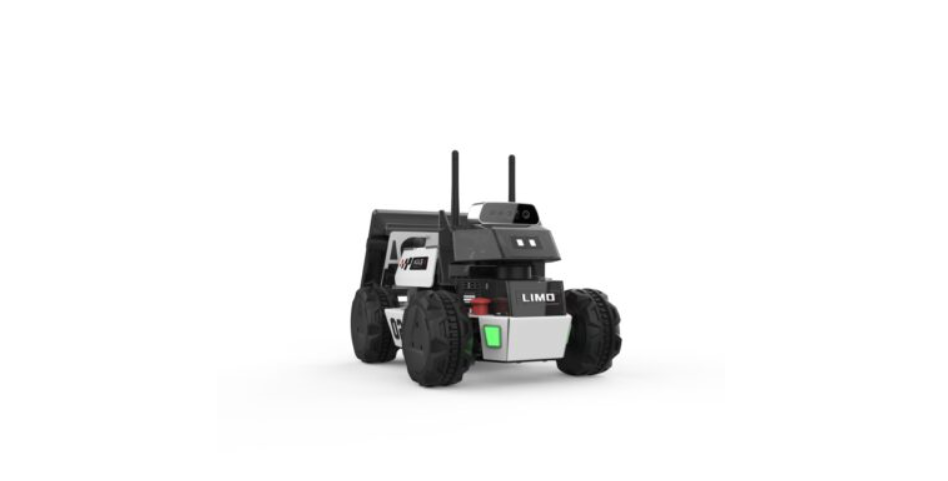
AgileX Robotics is using NVIDIA Jetson modules to power the AI autonomy and visual capabilities of its mobile robots, while leveraging NVIDIA Isaac Sim—an open-source reference robot simulation framework built on NVIDIA Omniverse—to advance simulation work.
Canonical is streamlining the robotics development workflow, while launching a fully open-source observability stack demo for ROS 2 devices running on Ubuntu systems. This demo is now available on the NVIDIA Jetson AGX Thor platform, which is designed for robotics and edge computing.
Ekumen Labs has integrated NVIDIA Isaac Sim into its robotics development workflow. This integration not only provides a physically realistic simulation environment for testing and validating real-world systems but also supports the generation of high-fidelity synthetic data.
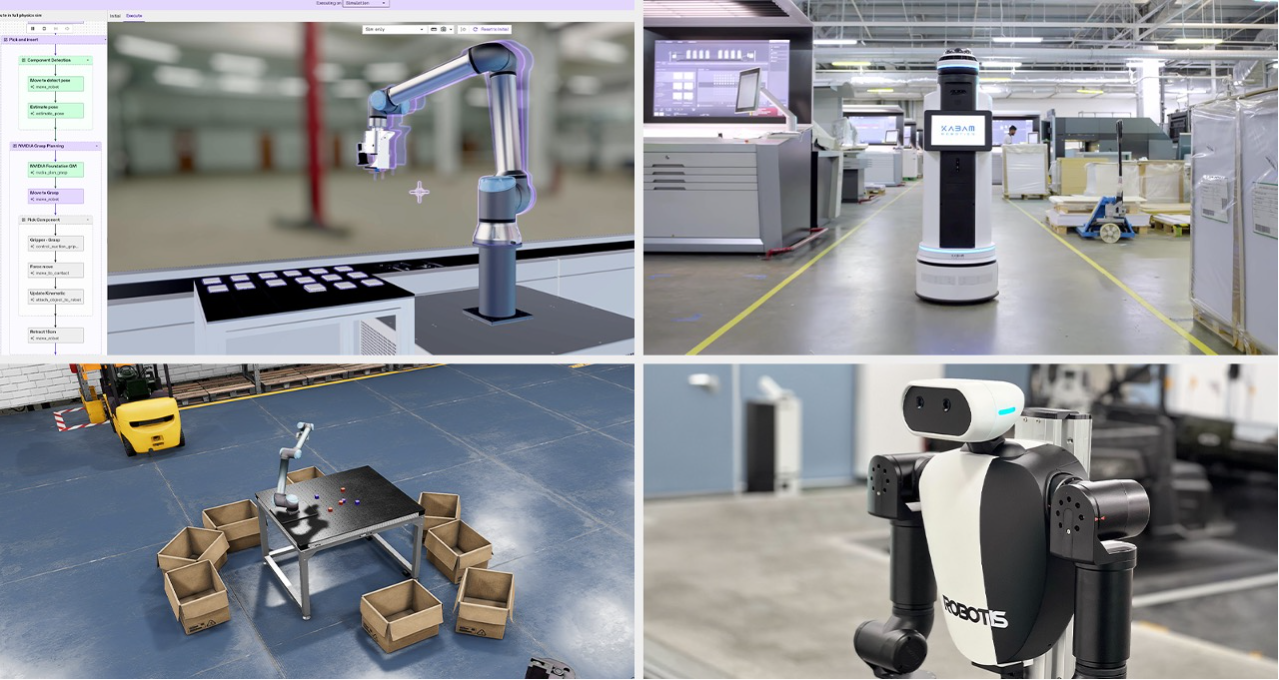
Intrinsic has integrated NVIDIA Isaac foundational models and Omniverse simulation tools into its Flowstate platform, equipping industrial robots with three core capabilities: advanced grasping functionality, real-time digital twin visualization, and seamless AI-driven automation.
KABAM Robotics’ Matrix robot, powered by NVIDIA Jetson Orin and NVIDIA Triton Inference Server on the ROS 2 Jazzy system, delivers advanced security and facility management capabilities in complex outdoor environments.
At this year’s ROSCon, Steve Macenski, founder of Open Navigation, delivered a keynote speech titled “On the Application of Nav2 Paths.” He showcased multiple NVIDIA technologies, including NVIDIA Isaac Sim and NVIDIA SWAGGER, to demonstrate advanced route navigation capabilities for autonomous mobile robots.